SEVEN wonders
index

A scroll film

Six are gone, one stands.

The classical list names seven. Follow the dot to what is left of each.

Seven places

All seven fit inside 2,200 kilometres.

From Olympia in Greece to Babylon in Iraq. Pick a pin, or a name below.

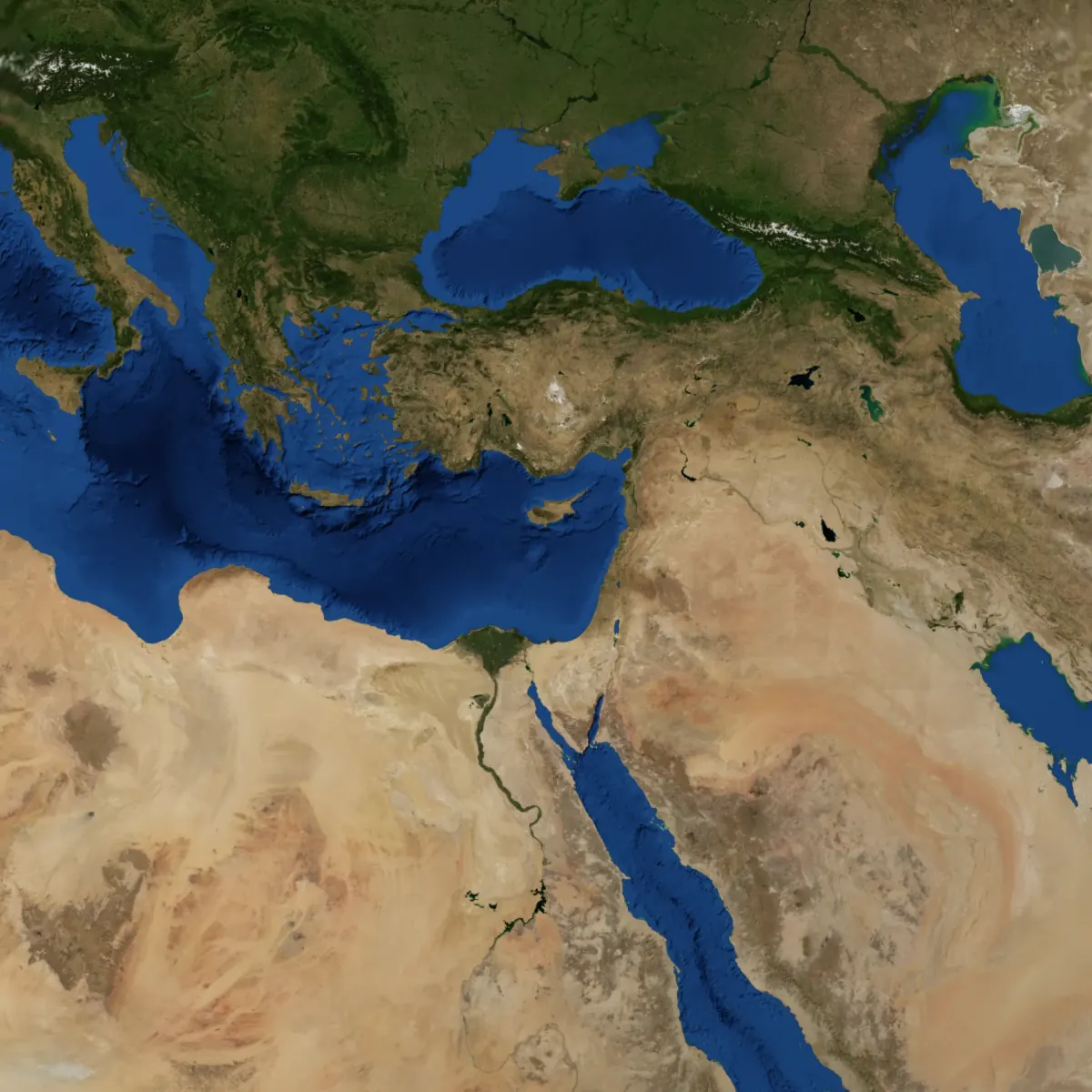
From Olympia in the west to Babylon in the east. The Gardens marker locates the ancient city, not a known garden site. Satellite image: NASA Earth Observatory.Great PyramidHanging GardensArtemis TempleStatue of ZeusMausoleumColossusLighthouse
From Olympia in the west to Babylon in the east. The Gardens marker locates the ancient city, not a known garden site. Satellite image: NASA Earth Observatory.

Great Pyramid of Giza

The only one still standing.

Place today
Giza, Egypt
Coordinates
29.9792 N, 31.1342 E5
Built
c. 2580–2560 BC56
Today
standing
Site
known

Giza, Egypt · c. 2560 BC

Built for Khufu, still standing.

Finished around 2560 BC by one common chronology; others put it decades later. It is the only one of the seven wonders still standing.456715

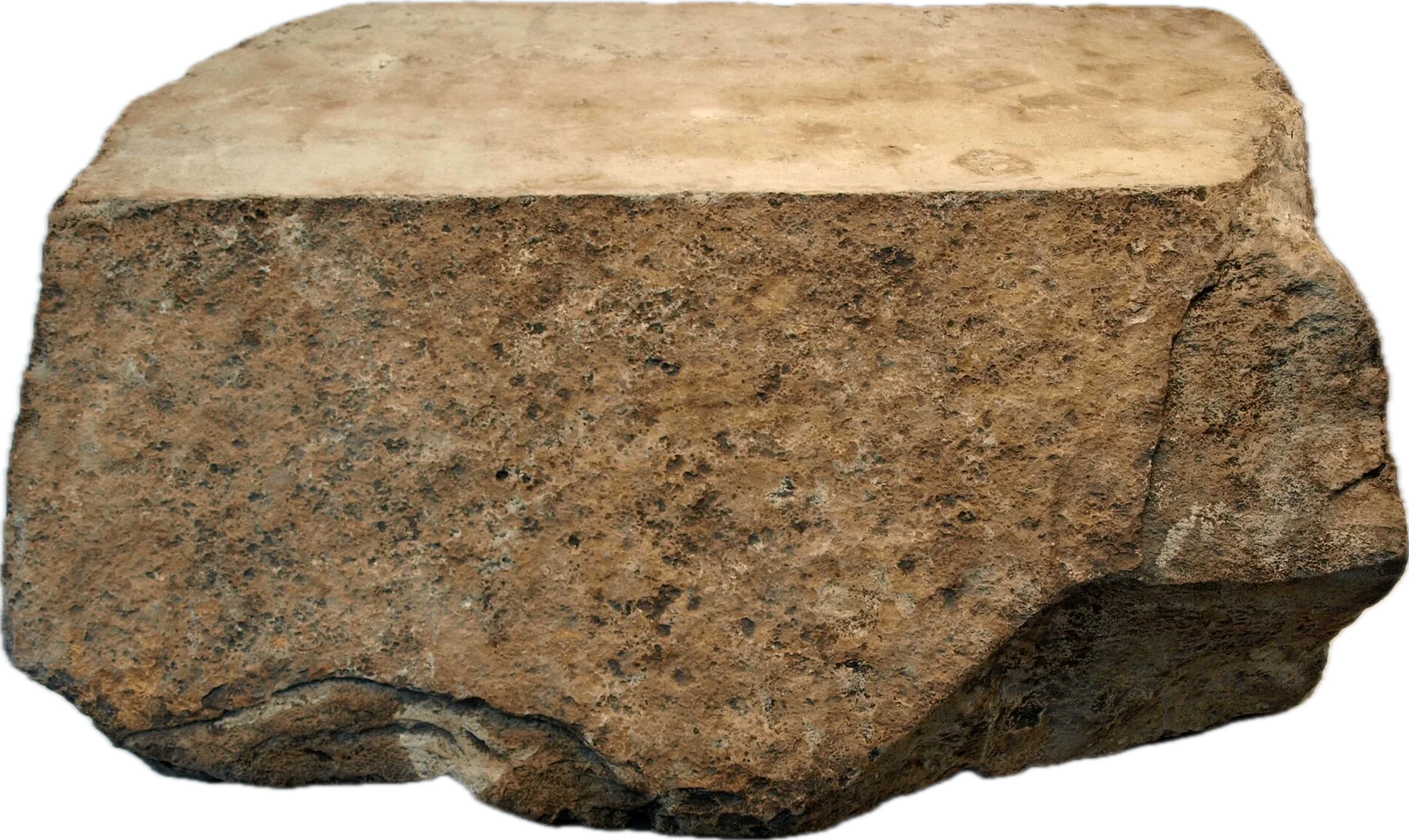
A Tura limestone casing block from the Great Pyramid, British Museum EA 490
Casing stone of the Great Pyramid, EA 490. CaptMondo. CC BY 2.5.

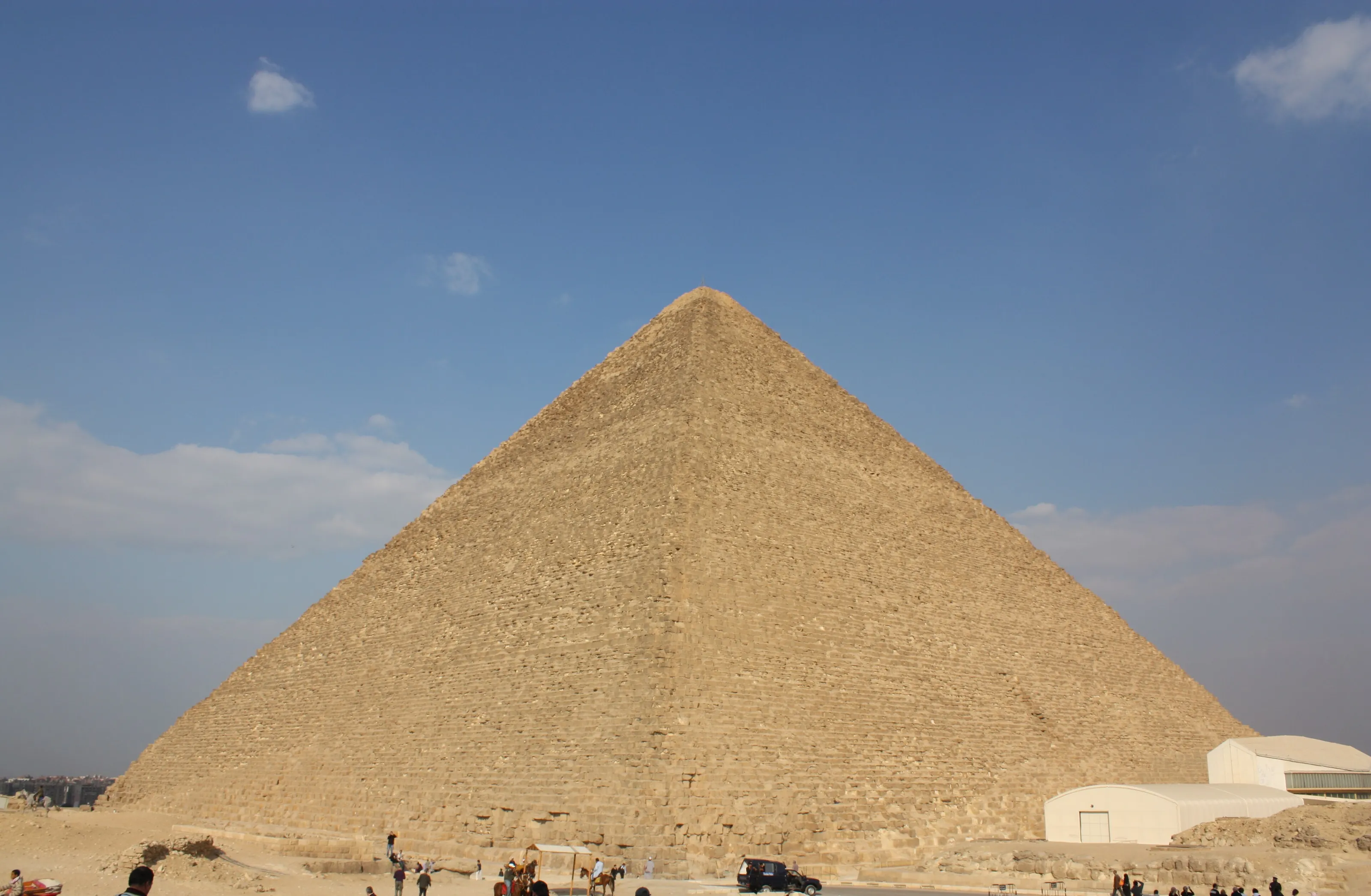
Giza, photographed in 2010

Built smooth, now stepped.

The steps are the core of yellowish limestone. The smooth white casing, brought from quarries at Tura, 15 km upriver, is gone from most of it.41013

The Great Pyramid of Khufu from the southwest, the west face on the left and the south face on the right, with the boat museum at the right-hand base and people, a camel and a car in front
Great Pyramid of Giza. Wknight94. CC BY-SA 3.0.

Then: Smooth, white, pointed.

The faces met at a tip about 146.5 m up. Britannica counts about 2.3 million blocks; a NOVA teaching page of 1997 puts the average at about 2.3 tonnes and does not say whose estimate that is.14511

The drawn outline over the present-day photograph. Solid: seen on the pyramid today. Dashed or hatched: the lost casing and tip, worked out from the slope. The Great Pyramid as built, drawn over the photo giza-today: lines The core as it stands: north-west arris, the broken summit, south-east arris (photo) The core as it stands: south-west arris (photo) Foot of the casing on the pavement: casing in situ, corner sockets (Petrie § 20, § 26) Corners of the casing: the rock-cut sockets (Petrie § 20) Arris of the lost casing up to the lost tip: from the base and the slope (Petrie § 24 to § 26) Arris of the lost casing up to the lost tip: from the base and the slope (Petrie § 24 to § 26) Arris of the lost casing up to the lost tip: from the base and the slope (Petrie § 24 to § 26)
The drawn outline over the present-day photograph. Solid: seen on the pyramid today. Dashed or hatched: the lost casing and tip, worked out from the slope.
Solid: seen on the pyramid today.
attested by remains
Dashed or hatched: the lost casing and tip, worked out from the slope.
known from texts or inferred

One floor line, one scale

About 147 metres, when new.

Lincoln Cathedral says its spire of 1311 reached 160 m and made it the tallest building in the world, more than 3,800 years after the pyramid was finished. Britannica says “reputedly”; the spire fell in 1548.51718

From left to right, at one scale: Great Pyramid, as built: 146.5 m; Eiffel Tower: 330 m; Statue of Liberty: 93 m; A person: 1.7 m. Solid: attested by remains. Dashed: known from texts or inferred.

Heights

  • Great Pyramid, as built 146.5 m Today 137 m (Britannica) or 139 m (Procureur et al., 2023), without its casing and tip.14516
  • Eiffel Tower 330 m Today’s height, 1,083 ft; built for 1889.20
  • Statue of Liberty 93 m From the ground to the tip of the torch, 305 ft 1 in.19
  • A person 1.7 m A round figure: US adults average 1.75 m (men) and 1.61 m (women).21

Inside, in order

Mostly solid stone.

Three chambers, a few passages and five low rooms above the King’s Chamber. Muon imaging has since found two more spaces.41516

Section / North left. Three chambers, a few passages and five low rooms above the King’s Chamber. Muon imaging has since found two more spaces. Solid: attested by remains. Dashed: known from texts or inferred.

The route inside

  1. Entrance, north face

    The doorway was built into the casing, about 17 m above the ground. Visitors’ way in is a rough tunnel cut beside it.

    The original doorway lay about 17 m above the ground and 7 m east of the middle of the north face, hidden behind the casing. The tunnel beside it was forced through the stone, by tradition for Caliph al-Ma’mun around 820. The accounts of it were written centuries later.214

    attested by remains

  2. Descending passage and rock chamber

    A sloping passage drops through the masonry into the rock and ends in a chamber that was never finished.

    From the entrance a sloping passage runs down through the masonry and into the bedrock. At its end lies an underground chamber, cut roughly and left unfinished. Britannica notes that the pyramid’s subterranean chambers were never completed.24

    attested by remains

  3. Ascending passage

    A branch climbs from the descending passage towards the Grand Gallery. Granite plugs still block its lower end.

    Granite plugs, some 15 feet (4.6 m) of them, still fill the lower part of the passage, as Petrie measured in 1881–82. The forced tunnel runs around them and joins the passage above, below the Grand Gallery.214

    attested by remains

  4. Queen’s Chamber and its shafts

    A room of about 5.2 by 5.8 m with a pointed roof. Two narrow shafts leave it; Waynman Dixon found them in 1872.

    Petrie measured 5.23 by 5.75 m. The two channels start level, then turn upwards. They were closed by a thin skin of stone in the wall until Dixon opened them. Three small objects found in 1872 are known as the Dixon relics. What the shafts were for is not known.241213

    attested by remains

  5. King’s Chamber and the rooms above

    A granite room of about 10.5 by 5.2 m. Five low chambers stand over its ceiling.

    Walls, floor and ceiling are granite, with a red granite coffer. The ceiling beams, some 400 tons, are cracked, probably by an earthquake. Above them lie five chambers; Howard Vyse forced his way into them in 1837. Two shafts run from this chamber to the outside.24

    attested by remains

  6. Two voids, found by muons

    Muon imaging found a void above the Grand Gallery, at least 30 m long, reported in 2017, and a corridor behind the north face, first seen in 2016–17 and measured at about 9 m in 2023.

    2017: a void with a cross-section like the Grand Gallery’s and a length of at least 30 m, seen by three kinds of muon detector. 2023: a corridor of about 9 m, 2 m by 2 m across, behind the north face, first seen in 2016–17. Both are inferred from muon counts. No purpose is known.1516

    known from texts or inferred

Four from Giza, one related

Five things, four from Giza.

Hildesheim, London, Vienna and Paris hold the four that were found at Giza. The fifth carries Khufu’s name and was found at Lisht, reused by a later king.

  1. Statue of Hemiunu
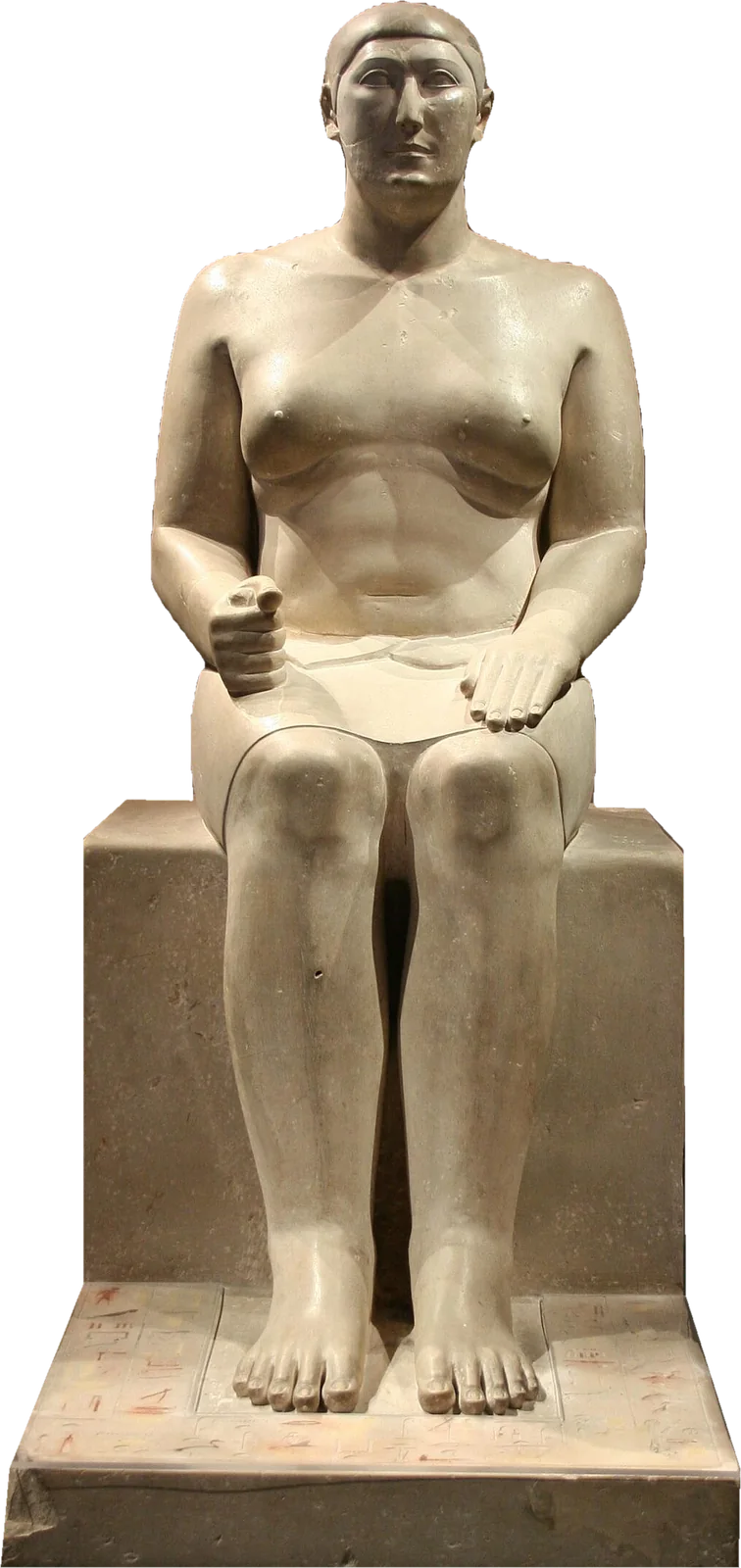
    Seated limestone statue of Hemiunu on its block seat and inscribed base
    Statue of Hemiunu. Einsamer Schütze. CC BY-SA 3.0.
    Date
    Dynasty 4, reign of Khufu
    Material
    Tura limestone
    Found
    Serdab of mastaba G 4000, Giza (Hermann Junker)
    Held
    Roemer- und Pelizaeus-Museum, Hildesheim, inv. 1962

    found here

    A king’s son and vizier, seated, found in the statue chamber of his tomb. His rank makes him the likely head of the building works; no inscription says so.

    Hemiunu’s mastaba, G 4000, lies in the cemetery west of the pyramid. The statue was found in place in the serdab, the statue chamber behind the north niche. Its inscription names him king’s son of his body and vizier. That he designed the pyramid is an inference from his rank, not a stated fact.222324

  2. Casing stone
    A Tura limestone casing block from the Great Pyramid, British Museum EA 490
    Casing stone of the Great Pyramid, EA 490. CaptMondo. CC BY 2.5.
    Date
    Dynasty 4
    Material
    Limestone
    Found
    The Pyramid of Khufu, Giza. The museum’s record names no closer place
    Held
    British Museum, London, EA 490

    found here

    A fragment of one of the limestone blocks that once made the pyramid’s faces smooth. It is 65 cm wide.

    The British Museum records a fragment of a limestone casing block from the Pyramid of Khufu, 65 cm wide and 50 cm deep. Colonel Howard Vyse gave it to the museum in 1838. By the 1800s most of the casing had been taken away for other buildings.1325

  3. Reserve head
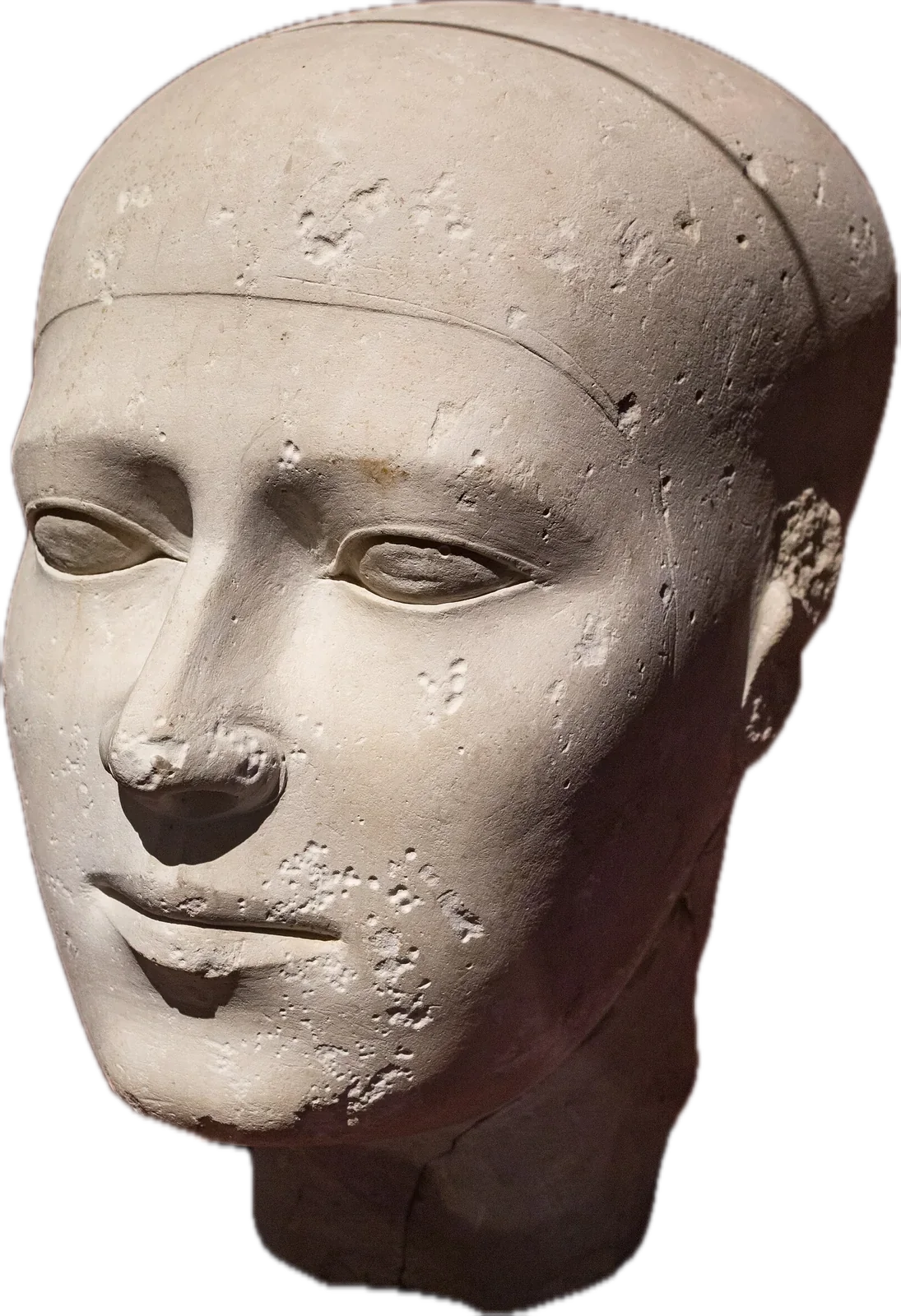
    Limestone reserve head from Giza, mastaba G 4350, the museum stand cut away
    Reserve head from Giza, Kunsthistorisches Museum ÄS INV 7787. ArchaiOptix. CC BY-SA 4.0.
    Date
    Dynasty 4, reign of Khufu
    Material
    Limestone
    Found
    Mastaba G 4350, Western Cemetery, Giza (excavated by Hermann Junker’s expedition)
    Held
    Kunsthistorisches Museum, Vienna, INV 7787

    found here

    A head without a body, 28 cm high, set in a tomb for the dead. A few more than thirty are known from Khufu’s reign.

    Reserve heads are free-standing, cut flat at the neck and carry no inscription. They stood at the foot of the burial shaft or in the burial chamber. Their purpose is still unexplained. The museum thinks that the damage to the ears and to the back and crown of this head probably had a magical function.2627

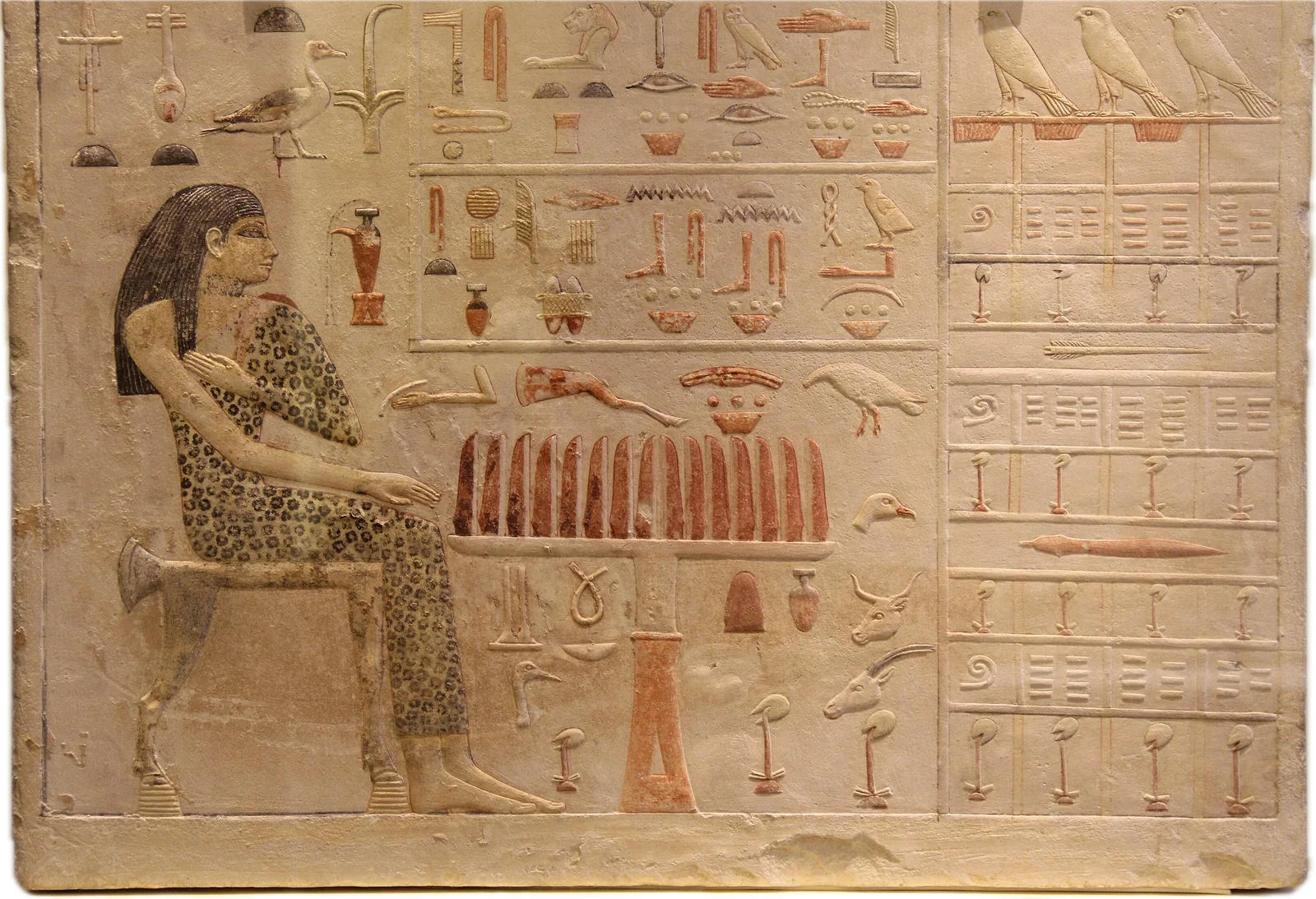
  4. Stela of Princess Nefertiabet
    Painted limestone slab stela of Nefertiabet, Louvre E 15591
    Ancient Egypt Limestone Bas-Relief. Gary Todd from Xinzheng, China. CC0.
    Date
    Dynasty 4, reigns of Khufu to Khafre
    Material
    Painted limestone
    Found
    Mastaba G 1225, Giza, 1902 (Montague Ballard)
    Held
    Louvre, Paris, E 15591

    found here

    A king’s daughter sits at a table of offerings in a leopard-skin dress. The slab lists the food, cloth and cosmetics she was to receive.

    Nefertiabet is called king’s daughter. Her tomb, G 1225, stands in the Western Cemetery near the pyramid. The Louvre calls her a sister or a daughter of Khufu. Atherton Curtis gave the stela to the museum in 1938.303132

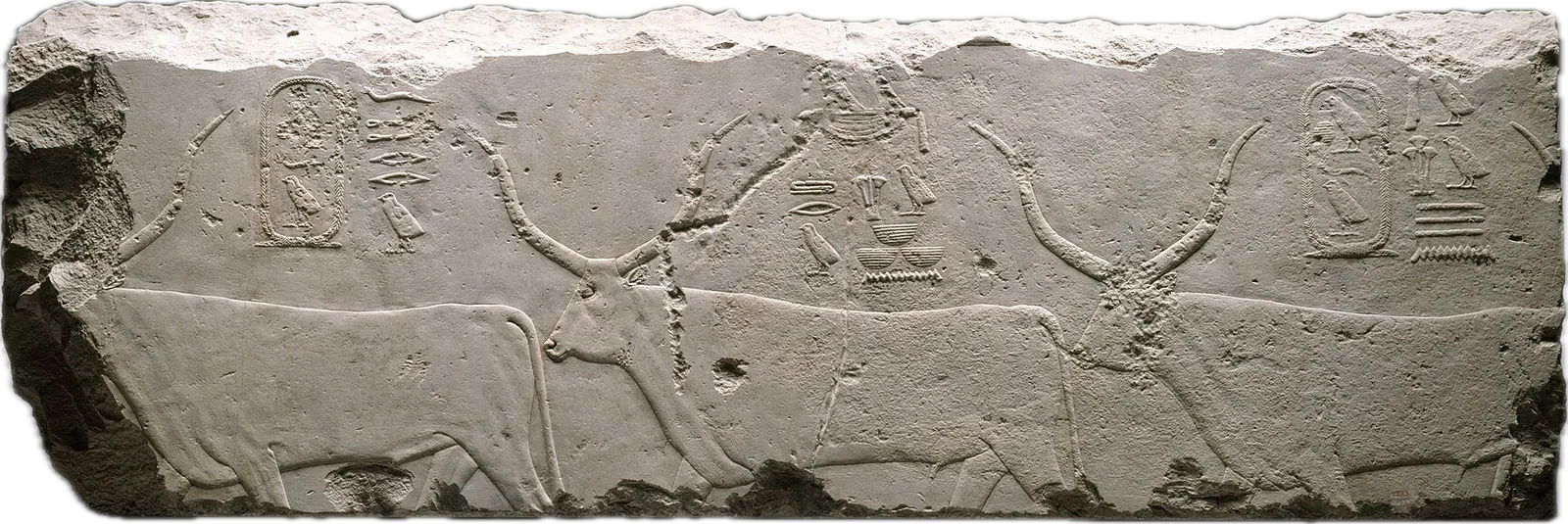
  5. Relief with Khufu’s cattle
    Limestone relief of two cattle, titled king Khufu's cattle, Metropolitan Museum 22.1.3a, b
    Relief, king Khufu's cattle. Metropolitan Museum of Art. CC0.
    Date
    Dynasty 4, reign of Khufu
    Material
    Limestone
    Found
    Lisht North, Egypt, reused as foundation of a mastaba by the pyramid of Amenemhat I. Not found at Giza
    Held
    Metropolitan Museum of Art, New York, 22.1.3a, b

    related piece, not from this wonder

    Three long-horned cattle, each labelled with Khufu’s name. A catalogue of the Lisht blocks places it in Khufu’s monument at Giza, but it was found at Lisht.

    Amenemhat I, first king of the 12th dynasty, took blocks from older buildings and used them in his pyramid at Lisht. Goedicke assigned this one to Khufu’s monument at Giza, perhaps its valley temple, from the king’s name and the style. The Met reads the cattle as probable offerings for Khufu’s funerary cult.2829

It did not fall

Stripped, but not fallen.

Nothing brought it down. By the 1800s most of its casing had been taken for other buildings, and people had cut into it and measured it.31314

The surviving outline after the losses described below. Nothing brought it down. By the 1800s most of its casing had been taken for other buildings, and people had cut into it and measured it.

Timeline

  1. 2560 BC Finished for Khufu, cased in white limestone. Herodotus was told it took 20 years and 100,000 men; Egyptologists now think of about 20,000 workers.58913
  2. 820 By tradition, Caliph al-Ma’mun’s men cut a tunnel into the north face. The accounts are centuries younger than the event.14
  3. 1800 By the 1800s most of the casing has been taken for other buildings. A few stones remain at the foot.113
  4. 1837 Howard Vyse cuts his way into the chambers above the King’s Chamber. Petrie also credits him with first finding the casing and the pavement at the north foot, without a year.12
  5. 1881 Petrie begins his survey; by 1882 he has the base at about 230.3 m. Casing chips from the heaps at its foot are being carted off to mend a road.13
  6. 2017 Muon imaging finds a void above the Grand Gallery, the first major inner structure found since the 1800s.15

Sources

  1. W. M. Flinders Petrie, The Pyramids and Temples of Gizeh (1883), ch. 6, §§ 20–27, pp. 37–45 https://web.archive.org/web/20240621013305/https://www.ronaldbirdsall.com/gizeh/petrie/c6.html
  2. W. M. Flinders Petrie, The Pyramids and Temples of Gizeh (1883), ch. 7, §§ 35–64, pp. 55–95 https://web.archive.org/web/20220606155948/http://www.ronaldbirdsall.com/gizeh/petrie/c7.html
  3. W. M. Flinders Petrie, The Pyramids and Temples of Gizeh (1883), ch. 4, § 14, p. 29 https://web.archive.org/web/20200218175553/http://www.ronaldbirdsall.com:80/gizeh/petrie/c4.html
  4. Encyclopaedia Britannica, “Great Pyramid of Giza” (reference work) https://www.britannica.com/topic/Great-Pyramid-of-Giza
  5. Pleiades gazetteer (ISAW, New York University), “The Great Pyramid”, place 704360201 https://pleiades.stoa.org/places/704360201
  6. Ancient Egypt Research Associates, “How Old Are the Pyramids?” https://aeraweb.org/projects/how-old-are-the-pyramids/
  7. UNESCO World Heritage Centre, “Memphis and its Necropolis – the Pyramid Fields from Giza to Dahshur” (inscribed 1979) https://whc.unesco.org/en/list/86/
  8. Herodotus, Histories 2.124–125 (trans. A. D. Godley, 1920) https://www.perseus.tufts.edu/hopper/text?doc=Perseus%3Atext%3A1999.01.0126%3Abook%3D2%3Achapter%3D124
  9. Zahi Hawass and Mark Lehner, “Builders of the Pyramids”, Archaeology 50.1 (January/February 1997), opening paragraph https://archive.archaeology.org/9701/abstracts/pyramids.html
  10. Wikimedia Commons, file page of the photograph “Great Pyramid of Giza 2010” by Wknight94 (taken 6 February 2010; the record of the picture itself) https://commons.wikimedia.org/wiki/File:Great_Pyramid_of_Giza_2010.jpg
  11. NOVA Online, “Pyramids: Scaling the Pyramids, Blocks” (WGBH/PBS, 1997; teaching page) https://www.pbs.org/wgbh/nova/pyramid/geometry/blocks.html
  12. University of Aberdeen, “Missing 5,000-year-old piece of Great Pyramid puzzle discovered in cigar box in Aberdeen” (16 December 2020; on the Dixon relics) https://www.abdn.ac.uk/news/14573/
  13. National Museums Scotland, “Casing stone from the Great Pyramid of Giza” (A.1955.176) https://www.nms.ac.uk/discover-catalogue/casing-stone-from-the-great-pyramid-of-giza
  14. Smithsonian Magazine, “Inside the Great Pyramid” (feature; magazine, not a primary study) https://www.smithsonianmag.com/travel/inside-the-great-pyramid-75164298/
  15. K. Morishima et al., “Discovery of a big void in Khufu’s Pyramid by observation of cosmic-ray muons”, Nature 552 (2017), 386–390 https://www.nature.com/articles/nature24647
  16. S. Procureur et al., “Precise characterization of a corridor-shaped structure in Khufu’s Pyramid by observation of cosmic-ray muons”, Nature Communications 14 (2023), 1144 https://www.nature.com/articles/s41467-023-36351-0
  17. Lincoln Cathedral, “Timeline of historical events” (entries 1311 and 1548) https://lincolncathedral.com/timeline/
  18. Encyclopaedia Britannica, “Lincoln Cathedral” (reference work) https://www.britannica.com/place/Lincoln-Cathedral
  19. US National Park Service, “Statue Statistics”, Statue of Liberty National Monument https://www.nps.gov/stli/learn/historyculture/statue-statistics.htm
  20. Eiffel Tower (official site), “Key figures” https://www.toureiffel.paris/en/the-monument/key-figures
  21. US CDC National Center for Health Statistics, “Body Measurements” (US adults 20+, 2015–2018) https://www.cdc.gov/nchs/fastats/body-measurements.htm
  22. Digital Giza (Harvard University), object record “Statue of Hemiunu”, RPM_1962 https://giza.fas.harvard.edu/objects/54706/full/
  23. Digital Giza (Harvard University), person record “Hemiunu (G 4000)” https://giza.fas.harvard.edu/ancientpeople/1186/full/
  24. egyptianmuseum.org, “Old Kingdom Architects: Hemiunu” (museum-style page; owner of the site not verified) https://egyptianmuseum.org/explore/old-kingdom-architects-hemiunu
  25. British Museum, collection record EA 490, “pyramid-casing” (fragment of a limestone casing block from the Pyramid of Khufu) https://www.britishmuseum.org/collection/object/Y_EA490
  26. Kunsthistorisches Museum Wien, collection record “Reserve head”, Ägyptische Sammlung INV 7787 https://www.khm.at/en/artworks/reserve-head-322358-1
  27. Digital Giza (Harvard University), object record “Limestone reserve head”, KHM_ÄS_7787 https://giza.fas.harvard.edu/objects/45227/full/
  28. Metropolitan Museum of Art, “Relief fragment with king Khufu’s cattle”, 22.1.3a, b (collection record, Open Access) https://www.metmuseum.org/art/collection/search/543890
  29. Hans Goedicke, Re-Used Blocks from the Pyramid of Amenemhet I at Lisht (Metropolitan Museum of Art Egyptian Expedition 20, 1971), no. 4, pp. 18–19 https://www.metmuseum.org/met-publications/re-used-blocks-from-the-pyramid-of-amenemhet-i-at-lisht
  30. Musée du Louvre, collection record “Stèle de Néfertiabet”, E 15591 https://collections.louvre.fr/en/ark:/53355/cl010005261
  31. Musée du Louvre, “La Stèle de Néfertiabet”, L’Œuvre en scène (22 January 2025) https://www.louvre.fr/expositions-et-evenements/evenements-activites/la-stele-de-nefertiabet
  32. Digital Giza (Harvard University), person record “Nefretiabet (G 1225)” https://giza.fas.harvard.edu/ancientpeople/1736/full/

Hanging Gardens of Babylon

No site confidently identified, perhaps not in Babylon.

Place today
Babylon, Iraq
Coordinates
32.5373 N, 44.4250 E12
Built
605–562 BC, if built by Nebuchadnezzar II7919
Ended
unknown222
Today
lost
Site
disputed

The film of this wonder is not built yet.

Sources

  1. Pleiades gazetteer (ISAW, New York University), “Babylon”, place 893951: representative point 32.53729695 N, 44.42497815 E https://pleiades.stoa.org/places/893951/json
  2. Pleiades gazetteer, “Hanging Gardens of Babylon”, place 55248061: same representative point as “Babylon”; the description says the location in the city is unclear, with no definitive archaeological evidence https://pleiades.stoa.org/places/55248061/json
  3. Diodorus Siculus, Library of History 2.10 (the garden) and 2.7 (the walls of Babylon), Loeb Classical Library, vol. I (1933), as given on LacusCurtius; Greek text also printed in Koldewey, The Excavations at Babylon, ch. XIV https://penelope.uchicago.edu/Thayer/E/Roman/Texts/Diodorus_Siculus/2A*.html
  4. Strabo, Geography 16.1.5 (the walls and the hanging garden), Loeb Classical Library, vol. VII, as given on LacusCurtius; Greek text also printed in Koldewey, The Excavations at Babylon, ch. XIV https://penelope.uchicago.edu/Thayer/E/Roman/Texts/Strabo/16A*.html
  5. Quintus Curtius Rufus, History of Alexander 5.1.32–33, trans. John Yardley, as given on Livius.org, “Curtius Rufus on Alexander entering Babylon” https://www.livius.org/sources/content/curtius-rufus/alexander-the-great-enters-babylon/
  6. Quintus Curtius Rufus, History of Alexander 5.1.32–35, Latin text on LacusCurtius (Thayer’s site): the pillars, the trees, the walls and “Syriae regem Babylone regnantem” https://penelope.uchicago.edu/Thayer/L/Roman/Texts/Curtius/5*.html
  7. Flavius Josephus, Against Apion, book 1, § 141 (trans. William Whiston), quoting Berossus; also Antiquities of the Jews 10.11, Greek text printed in Koldewey, The Excavations at Babylon, ch. XIV https://lexundria.com/j_ap/1.141/wst
  8. Livius.org (Jona Lendering), “Berossus on Nebuchadnezzar” (Josephus, Against Apion, in Whiston’s translation): the palace, the “pensile paradise” and the Median queen https://livius.org/sources/content/berossus-on-nebuchadnezzar
  9. Livius.org (Jona Lendering), “Babylon, Hanging Gardens” (created 2010, last modified 6 August 2020): Nebuchadnezzar II “(r. 605-562)”; the ancient authors; Berossus as a Babylonian author of the third century BC, known to Josephus through Alexander Polyhistor; the garden passage as likely added from Cleitarchus; Koldewey “admitted that he was not convinced himself” https://www.livius.org/articles/place/babylon/babylon-hanging-gardens/
  10. Livius.org (Jona Lendering), “Berossus” (created 2001, last modified 11 October 2019): a Babylonian priest who wrote a Greek history of Babylonia, dedicated to Antiochus I; published in 278 BC according to Tatian https://www.livius.org/articles/person/berossus/
  11. Philip Smith, “Cubitus”, in William Smith (ed.), A Dictionary of Greek and Roman Antiquities (London: John Murray, 1875), p. 372, as given on LacusCurtius: the cubit “equal to a foot and a half”, the Greek cubit “a little more … than a foot and a half English” https://penelope.uchicago.edu/Thayer/E/Roman/Texts/secondary/SMIGRA*/Cubitus.html
  12. Robert Koldewey, The Excavations at Babylon (trans. Agnes S. Johns, London: Macmillan, 1914), ch. XIV, “The Vaulted Building”, pp. 91–100, with the ancient passages he prints in Greek and Latin and his Fig. 62, “Section through the Vaulted Building” https://www.gutenberg.org/ebooks/71398
  13. Robert Koldewey, The Excavations at Babylon (1914), introduction: the digging begins on 26 March 1899; the list of the years, “1903. The north-east corner of the Southern Citadel with the vaulted building was explored, December 1902–January 1904” https://www.gutenberg.org/ebooks/71398
  14. Robert Koldewey, The Excavations at Babylon (1914), ch. I, “The Outer City Walls” (the walls as dug) and the chapter “The Ishtar Gate” (“walls which still stand 12 metres high”) https://www.gutenberg.org/ebooks/71398
  15. University of Münster, “A short history of excavations and investigations in Babylon”: the German excavation 26 March 1899 to 7 March 1917; the Iraqi excavations 1979–81 https://www.uni-muenster.de/GoviB/babylon/excavationhistory.html
  16. UNESCO World Heritage Centre, “Babylon” (inscribed 2019; news item “Five sites inscribed on UNESCO’s World Heritage List”, 5 July 2019): Outstanding Universal Value, Integrity and Authenticity https://whc.unesco.org/en/list/278/
  17. Frauke Weiershäuser and Jamie Novotny, “Nebuchadnezzar II 002” (the East India House inscription, BM 129397), Royal Inscriptions of Babylonia online (Oracc/MOCCI), translation and notes 50–51: “The creation of a garden is not mentioned in this inscription, nor in any other extant text of Nebuchadnezzar”; the introduction: “Nabopolassar’s death in 605” http://oracc.org/ribo/Q005473/
  18. Stephanie Dalley, “Nineveh, Babylon and the Hanging Gardens: cuneiform and classical sources reconciled”, Iraq 56 (1994), pp. 45–58; the opening extract (the full text could not be opened) https://www.cambridge.org/core/journals/iraq/article/abs/nineveh-babylon-and-the-hanging-gardens-cuneiform-and-classical-sources-reconciled1/C024A9417036B87AB6D772A98274E0D0
  19. Stephanie Dalley, “The mystery of the Hanging Garden of Babylon”, OUPblog, 17 June 2013 (her own summary of the argument of her book of 2013) https://blog.oup.com/2013/06/mystery-hanging-garden-babylon/
  20. Centre for the Study of Manuscript Cultures, University of Hamburg, Mesopotamian Bulletin, 30 January 2018, “The Hanging Gardens of Babylon were at … Nineveh!” (a summary of Dalley’s argument; no author named) https://www.csmc.uni-hamburg.de/publications/mesopotamia/2018-01-30.html
  21. Benjamin Leonard, “Hanging Garden”, Archaeology magazine, November/December 2025 (“Secrets of the Seven Wonders”) https://archaeology.org/issues/november-december-2025/collection/hanging-garden/secrets-of-the-seven-wonders/
  22. Julian Reade, “Alexander the Great and the Hanging Gardens of Babylon”, Iraq 62 (2000), pp. 195–217; the opening extract (the full text could not be opened) https://cambridge.org/core/journals/iraq/article/alexander-the-great-and-the-hanging-gardens-of-babylon/6D7FD83FF93A9BCF77A0F852C430E7C2
  23. Thorkild Jacobsen and Seton Lloyd, Sennacherib’s Aqueduct at Jerwan (Oriental Institute Publications 24, Chicago, 1935), ch. II “Architectural description”, p. 6, and ch. III, p. 33 (the garden text of 703 BC) https://archive.org/details/oip24
  24. Encyclopaedia Britannica, “Hanging Gardens of Babylon” (reference work, updated 6 December 2025) https://www.britannica.com/place/Hanging-Gardens-of-Babylon
  25. Encyclopaedia Britannica, “Merodach-baladan II” (reference work): king of Babylonia 721–710 BC and for nine months in 703 BC https://www.britannica.com/biography/Merodach-baladan-II
  26. Metropolitan Museum of Art, “Panel with striding lion”, 31.13.1 (collection record and object API; Open Access) https://www.metmuseum.org/art/collection/search/322585
  27. Metropolitan Museum of Art, “Cuneiform cylinder: inscription of Nebuchadnezzar II describing the construction of the outer city wall of Babylon”, 86.11.60 (collection record; Open Access) https://www.metmuseum.org/art/collection/search/321676
  28. British Museum, collection record 1938,0520.1 (BM 129397), “tablet”: the East India House Inscription (read in an archived copy of the record) https://www.britishmuseum.org/collection/object/W_1938-0520-1
  29. British Museum, collection record 1856,0909.36 (BM 124939,b), gypsum wall panel from the North Palace at Nineveh, Room H, panel 9 (read in an archived copy of the record) https://www.britishmuseum.org/collection/object/W_1856-0909-36
  30. British Museum, collection record 1881,0706.688 (BM 46226), “tablet”: a list of plants, utensils and personnel in the garden of Marduk-apla-iddina (read in an archived copy of the record) https://www.britishmuseum.org/collection/object/W_1881-0706-688
  31. Staatliche Museen zu Berlin, Vorderasiatisches Museum, “Ishtar Gate (reconstruction of the outer gate)”, VA Bab 1408–1456: height 14.73 m, width 26.41 m, depth 4.38 m (record on Google Arts & Culture) https://artsandculture.google.com/asset/ishtar-gate-reconstruction-of-the-outer-gate-unknown/DwG4vt3_ylapbQ
  32. US National Park Service, “Statue Statistics”, Statue of Liberty National Monument https://www.nps.gov/stli/learn/historyculture/statue-statistics.htm
  33. US CDC National Center for Health Statistics, “Body Measurements” (US adults 20+, August 2021–August 2023) https://www.cdc.gov/nchs/fastats/body-measurements.htm

Temple of Artemis at Ephesus

Burned in 356 BC, rebuilt, then quarried away.

Place today
Selçuk, Türkiye
Coordinates
37.9498 N, 27.3637 E1
Built
c. 575 BC; rebuilt after 356 BC31415
Ended
AD 262 (Goths); later quarried, burned by the Goths, then closed and quarried281017
Today
traces
Site
known

The film of this wonder is not built yet.

Sources

  1. Pleiades gazetteer (ISAW, New York University), “Temple of Artemis at Ephesus”, place 873985034 https://pleiades.stoa.org/places/873985034
  2. Encyclopaedia Britannica, “Temple of Artemis” (reference work) https://www.britannica.com/topic/Temple-of-Artemis-temple-Ephesus-Turkey
  3. Pliny the Elder, Natural History 36.95–97 (trans. Bostock and Riley, 1855: book 36, ch. 21) https://www.perseus.tufts.edu/hopper/text?doc=Perseus:text:1999.02.0137:book=36:chapter=21
  4. Pliny the Elder, Natural History 16.213 (trans. Bostock and Riley, 1855: book 16, ch. 79) https://www.perseus.tufts.edu/hopper/text?doc=Perseus:text:1999.02.0137:book=16:chapter=79
  5. Strabo, Geography 14.1.22–23 (trans. Hamilton and Falconer, 1903) https://www.perseus.tufts.edu/hopper/text?doc=Perseus:text:1999.01.0239:book=14:chapter=1:section=22
  6. Herodotus, Histories 1.26 and 1.92 (trans. A. D. Godley, 1920) https://www.perseus.tufts.edu/hopper/text?doc=Perseus:text:1999.01.0126:book=1:chapter=92
  7. Plutarch, Alexander 3 (trans. B. Perrin, 1919) https://www.perseus.tufts.edu/hopper/text?doc=Plut.+Alex.+3&fromdoc=Perseus%3Atext%3A1999.01.0244
  8. Historia Augusta, The Two Gallieni 6.2 (trans. D. Magie, 1924; his note gives 263; a late and unreliable source) https://penelope.uchicago.edu/Thayer/E/Roman/Texts/Historia_Augusta/Gallieni_duo*.html
  9. J. T. Wood, Discoveries at Ephesus, including the Site and Remains of the Great Temple of Diana (1877), pp. 12, 178–190, 238–246, 264–271 https://archive.org/details/discoveriesateph00wood
  10. D. G. Hogarth and others, Excavations at Ephesus: The Archaic Artemisia (British Museum, 1908), pp. 8, 11–12, 156–157, 247–249, 283–288, 294–295 (chapters by Hogarth, Henderson, A. H. Smith and Cecil Smith) https://archive.org/details/gri_33125000517827
  11. Aenne Ohnesorg, Der Kroisos-Tempel. Neue Forschungen zum archaischen Dipteros der Artemis von Ephesos, Forschungen in Ephesos XII/4 (Austrian Academy of Sciences, 2007), abstract https://austriaca.at/3477-0
  12. Ohnesorg 2007 (as above), ch. I, “Forschungsgeschichte und frühere Rekonstruktionen”, pp. 7–10 https://austriaca.at/0xc1aa5576_0x001669c6.pdf
  13. Ohnesorg 2007 (as above), ch. V, “Rekonstruktion des Aufrisses”, pp. 105–116 https://austriaca.at/0xc1aa5576_0x001669ca.pdf
  14. Ohnesorg 2007 (as above), ch. VII, “Datierung, Resümee und Ausblick”, pp. 127–131 https://austriaca.at/0xc1aa5576_0x001669cc.pdf
  15. Michael Weißl, “Grundzüge der Bau- und Schichtenfolge im Artemision von Ephesos”, Jahreshefte des Österreichischen Archäologischen Institutes 71 (2002), 313–346 https://austriaca.at/0xc1aa5576_0x00037510.pdf
  16. Austrian Academy of Sciences, Austrian Archaeological Institute, “The Artemision of Ephesos” (research page, archived copy) https://web.archive.org/web/2024/https://www.oeaw.ac.at/en/oeai/research/historical-archaeology/historical-archaeology-in-the-mediterranean/cult-and-sanctuary
  17. ICOMOS, evaluation of the nomination “Ephesus (Turkey)”, No 1018rev, 12 March 2015 (UNESCO World Heritage Centre, document 151544) https://web.archive.org/web/2024/https://whc.unesco.org/document/151544
  18. A. H. Smith, A Catalogue of Sculpture in the Department of Greek and Roman Antiquities, British Museum, vol. 2 (1900), no. 1206, pp. 174–176 https://archive.org/details/acataloguesculp02smitgoog
  19. Münzkabinett, Staatliche Museen zu Berlin, coin of Ephesus, Antoninus Pius, inv. 18269500 (record on museum-digital) https://smb.museum-digital.de/object/186943
  20. Daily Sabah (from Anadolu Agency), “Ephesus Museum reveals Türkiye’s journey from Mycenae to Ottomans” (news report quoting the museum director) https://www.dailysabah.com/arts/ephesus-museum-reveals-turkiyes-journey-from-mycenae-to-ottomans/news
  21. Kunsthistorisches Museum Wien, Antikensammlung, “Große Artemis von Ephesos” (plaster cast, XIV Z 276; its text describes the Roman statue type) https://www.khm.at/en/artworks/grosse-artemis-von-ephesos-705749-1
  22. Arrian, Anabasis 1.17.10–12 (trans. E. J. Chinnock, 1884; the text read is the one on Wikisource) https://en.wikisource.org/wiki/The_Anabasis_of_Alexander/Book_I/Chapter_XVII
  23. Diodorus Siculus, Library of History 17.17.1–2 (Perseus text of the Loeb translation, with the note “334/3 B.C.”) https://www.perseus.tufts.edu/hopper/text?doc=Perseus:text:1999.01.0084:book=17:chapter=17
  24. Ohnesorg 2007 (as above), ch. VI, “Ergänzende Beobachtungen und Überlegungen zum Kroisos-Tempel”, p. 120 (the layer under the foundations) https://austriaca.at/0xc1aa5576_0x001669cb.pdf
  25. British Museum, collection online, “column”, museum number 1872,0803.9 (archived copy; the live page answers 403) https://web.archive.org/web/2024/https://www.britishmuseum.org/collection/object/G_1872-0803-9
  26. File page of the photograph “Istanbul Archaeology Museum Ephesus exhibition, Figurine of a ram. Archaic Greek, oriental style, 7th century B.C.” (Wikimedia Commons, used only as the record of the picture) https://commons.wikimedia.org/wiki/File:Istanbul_Archaeology_Museum_Ephesus_exhibition_Figurine_of_a_ram._Archaic_Greek,_oriental_style,_7th_century_B.C._Ivory_1266.jpg
  27. Faya Causey, “Rams’ Heads”, in Ancient Carved Ambers in the J. Paul Getty Museum (Getty Publications, online edition) https://www.getty.edu/publications/ambers/objects/groups/8/
  28. File page of the photograph “Ephesos, 394–295 BC, silver tetradrachm, bee, stag, München SMS” (Wikimedia Commons, used only as the record of the picture; it copies the data of the Staatliche Münzsammlung München, SNG München 20 (1995), 27) https://commons.wikimedia.org/wiki/File:Ephesos_-_394-295_BC_-_silver_tetradrachm_-_bee_-_stag_-_M%C3%BCnchen_SMS.jpg
  29. Archäologisches Museum der Universität Münster, tetradrachm of Ephesos with the magistrate Hegekles, inv. M 3 (record on museum-digital; it cites SNG München 20, no. 27 and Kinns’s chronology) https://westfalen.museum-digital.de/object/8347
  30. Franz Miltner, “Bericht über die Ausgrabungen in Ephesos 1956”, Türk Arkeoloji Dergisi VII/1 (1957), pp. 20–25, here pp. 23–24 (German; Turkish Ministry of Culture archive) https://taed.ktb.gov.tr/Eklenti/109612,1957-miltner-20-25pdf.pdf
  31. Martin Steskal, Das Prytaneion in Ephesos, Forschungen in Ephesos IX/4 (Austrian Academy of Sciences, 2010), summary p. 239 (archived copy of the Heidelberg digital edition) https://web.archive.org/web/2024/https://digi.ub.uni-heidelberg.de/diglit/fie_bd9_4/0268
  32. J. Paul Getty Museum, “Statuette of Artemis of Ephesus”, 81.AA.134 (museum record) https://www.getty.edu/art/collection/object/103V2R
  33. Pleiades gazetteer (ISAW, New York University), “The Great Pyramid”, place 704360201 https://pleiades.stoa.org/places/704360201
  34. US CDC National Center for Health Statistics, “Body Measurements” (US adults 20+, 2015–2018) https://www.cdc.gov/nchs/fastats/body-measurements.htm

Statue of Zeus at Olympia

A god in gold and ivory. How it was lost is disputed.

Place today
Olympia, Greece
Coordinates
37.6380 N, 21.6306 E12
Built
c. 435–430 BC91117
Ended
AD 426, or about 50 years later (uncertain), uncertain: a fire at the temple, or a fire in Constantinople91120
Today
traces
Site
known

The film of this wonder is not built yet.

Sources

  1. Pausanias, Description of Greece 5.10 (trans. W. H. S. Jones and H. A. Ormerod, 1918): the temple, its sculptures and its doors https://www.perseus.tufts.edu/hopper/text?doc=Perseus%3Atext%3A1999.01.0160%3Abook%3D5%3Achapter%3D10
  2. Pausanias, Description of Greece 5.11 (trans. W. H. S. Jones and H. A. Ormerod, 1918): the statue, the throne, the floor in front of it https://www.perseus.tufts.edu/hopper/text?doc=Perseus%3Atext%3A1999.01.0160%3Abook%3D5%3Achapter%3D11
  3. Pausanias, Description of Greece 5.15.1 (trans. W. H. S. Jones and H. A. Ormerod, 1918): the workshop of Pheidias https://www.perseus.tufts.edu/hopper/text?doc=Perseus%3Atext%3A1999.01.0160%3Abook%3D5%3Achapter%3D15
  4. Pausanias, Description of Greece 5.26.1 (trans. W. H. S. Jones and H. A. Ormerod, 1918): the Nike of Paionios https://www.perseus.tufts.edu/hopper/text?doc=Perseus%3Atext%3A1999.01.0160%3Abook%3D5%3Achapter%3D26
  5. Strabo, Geography 8.3.30 (trans. H. L. Jones) https://www.perseus.tufts.edu/hopper/text?doc=Perseus%3Atext%3A1999.01.0198%3Abook%3D8%3Achapter%3D3%3Asection%3D30
  6. Wilhelm Dörpfeld, “Der Zeustempel”, in: E. Curtius and F. Adler (eds.), Olympia. Die Ergebnisse der von dem Deutschen Reich veranstalteten Ausgrabung, Textband II: Die Baudenkmäler (Berlin 1892), pp. 4–19 (excavator’s report, in German; the ramp is on p. 18, the table of measures on p. 19) https://archive.org/details/bub_gb_YpZZAAAAYAAJ
  7. Wilhelm Dörpfeld, Plate XII “Längenschnitt” (long section) of the temple of Zeus, in: Olympia. Die Ergebnisse …, Tafelband I: Die Baudenkmäler (Berlin 1892); digital copy of the Heidelberg University Library https://digi.ub.uni-heidelberg.de/diglit/curtius1892bd1/0016
  8. Georg Treu, Olympia. Die Ergebnisse …, Textband III: Die Bildwerke von Olympia in Stein und Thon (Berlin 1897), preface p. II (the six working winters, 4 October 1875 to 5 March 1881), p. 95 (the fall of the temple), p. 147 (the find list of the metopes), pp. 182–183 (the find of the Nike) (in German) https://archive.org/details/bub_gb_uuJZAAAAYAAJ
  9. N. Yalouris, “Olympia”, in: The Princeton Encyclopedia of Classical Sites (Princeton University Press, 1976; reference work) https://www.perseus.tufts.edu/hopper/text?doc=Perseus:text:1999.04.0006:entry=olympia
  10. UNESCO World Heritage Centre, “Archaeological Site of Olympia” (inscribed 1989), Outstanding Universal Value https://whc.unesco.org/en/list/517/
  11. Encyclopaedia Britannica, “Statue of Zeus” (reference work) https://www.britannica.com/topic/Statue-of-Zeus
  12. iDAI.gazetteer (German Archaeological Institute), “Zeus-Tempel”, place 2092350: 37.638043 N, 21.63057 E https://gazetteer.dainst.org/place/2092350
  13. A. Alexandris, I. Psycharis and E. Protopapa, “The collapse of the ancient temple of Zeus at Olympia revisited” (conference paper, 2nd European Conference on Earthquake Engineering and Seismology; the year is not printed in the file) https://eaee.org/Media/Default/2ECCES/2ecces_eaee/2002.pdf
  14. Johannes Gutenberg University Mainz, press release “Olympia hypothesis: Tsunamis buried the cult site on the Peloponnese” (11 July 2011; on the work of A. Vött) https://press.uni-mainz.de/?p=14389
  15. A. G. Leventis Foundation, “The Restoration of the Temple of Zeus, Olympia” (12 March 2013) https://www.leventisfoundation.org/heritage-conservation/second-phase-of-the-restoration-temple-of-zeus-olympia
  16. Archaeological Museum of Olympia (official site), “The Temple of Zeus” https://ancientolympiamuseum.com/index.php/2025/10/24/the-temple-of-zeus-2/
  17. Archaeological Museum of Olympia (official site), “The gold and ivory statue of Zeus” https://ancientolympiamuseum.com/index.php/2026/02/06/the-gold-and-ivory-statue-of-zeus/
  18. Archaeological Museum of Olympia (official site), “Research and excavations in Olympia” https://ancientolympiamuseum.com/index.php/2026/02/06/excavations/
  19. Themistoklis Bilis (German Archaeological Institute), “‘Phidias workshop’ in Olympia: new data and new interpretations”, 3rd International Conference on Ancient Greek and Byzantine Technology, Athens, 19–21 November 2024 https://edabyt.gr/wp-content/uploads/2025/02/TH.-BILIS-PHIDIAS-WORKSHOP-IN-OLYMPIA-NEW-DATA-AND-NEW-INTERPRETATIONS-n.pdf
  20. Georgius Cedrenus (11th century), Chronicle, on the statues in the palace of Lausus and its fire, in translation as quoted at “The Palace of Lausus”, Encyclopaedia Romana (hosted by the University of Chicago; a reading aid, not the Greek text) https://penelope.uchicago.edu/~grout/encyclopaedia_Romana/greece/hetairai/lausus.html
  21. US CDC National Center for Health Statistics, “Body Measurements” (US adults 20+, 2015–2018) https://www.cdc.gov/nchs/fastats/body-measurements.htm
  22. Galleria dell’Accademia di Firenze (the museum that holds it), “David”, data sheet and text: “The sculpture, with its carved base, is 517 cm high” https://www.galleriaaccademiafirenze.it/en/artworks/david-michelangelo/
  23. iDAI.objects (Arachne, German Archaeological Institute), record 1197209, “Schwarz gefirnißte Riefelkanne, sog. Pheidias-Kanne”, after A. Mallwitz and W. Schiering, Die Werkstatt des Pheidias in Olympia 1 (Olympische Forschungen 5, 1964), p. 169 no. 1, pl. 64 https://arachne.dainst.org/entity/1197209
  24. Classical Art Research Centre, University of Oxford, Beazley Archive Pottery Database, vase 9017151 (with the note of the Corpus of Attic Vase Inscriptions) https://www.carc.ox.ac.uk/record/36B0CAEF-AC90-4328-B07C-ED6782E1B9B2
  25. iDAI.objects (Arachne, German Archaeological Institute), record 1101643, “Westgiebel, Figur L, Apollon (Paus. 5, 10, 8)” https://arachne.dainst.org/entity/1101643
  26. iDAI.objects (Arachne, German Archaeological Institute), record 1083496, “Ostmetope 4, Herakles und die Äpfel der Hesperiden, sog. Atlasmetope”: Inv. L 95 https://arachne.dainst.org/entity/1083496
  27. iDAI.objects (Arachne, German Archaeological Institute), record 1101655, “Nike des Paionios” https://arachne.dainst.org/entity/1101655
  28. Münzkabinett, Staatliche Museen zu Berlin, online catalogue, “Elis: Zeus des Phidias”, object 18207826 https://ikmk.smb.museum/object?id=18207826
  29. Roman Provincial Coinage Online (Ashmolean Museum, Oxford), RPC III 321, Elis, Hadrian: “the Zeus of Phidias seated left” https://rpc.ashmus.ox.ac.uk/type/8796

Mausoleum at Halicarnassus

A tomb for Mausolus, later quarried for Bodrum Castle.

Place today
Bodrum, Türkiye
Coordinates
37.0378 N, 27.4242 E1
Built
c. 360–350 BC810
Ended
By 1522; the earlier collapse is undated, quarrying by the Knights of St John; possibly an earthquake before that610
Today
traces
Site
known

The film of this wonder is not built yet.

Sources

  1. Pleiades gazetteer (ISAW, New York University), “Mausoleum at Halicarnassus”, place 461581651 https://pleiades.stoa.org/places/461581651
  2. Pliny the Elder, Natural History 36.30–31 (trans. D. E. Eichholz, 1962, with alterations): the tomb, its measures, sculptors, pyramid and chariot https://www.attalus.org/translate/pliny_hn36a.html
  3. Vitruvius, On Architecture 2.8.10–11 (trans. Joseph Gwilt): Mausolus and the Mausoleum in the city https://penelope.uchicago.edu/Thayer/E/Roman/Texts/Vitruvius/2*.html
  4. Vitruvius, On Architecture 7, preface 12–13 (trans. Joseph Gwilt): Satyros, Pytheos and the sculptors https://penelope.uchicago.edu/Thayer/E/Roman/Texts/Vitruvius/7*.html
  5. C. T. Newton, A History of Discoveries at Halicarnassus, Cnidus and Branchidae, vol. II.1 (1862), ch. 4, pp. 86–105: digging on the site from 1 January 1857, the western stair, closing stone, foundations and the sculpture north of the precinct wall https://archive.org/details/ahistorydiscove01pullgoog
  6. C. T. Newton, A History of Discoveries at Halicarnassus, Cnidus and Branchidae, vol. II.1 (1862), ch. 3, pp. 72–81: the medieval notices, earthquake hypothesis, Knights, the account of 1522 and the removal of the frieze slabs from the castle walls in 1846 https://archive.org/details/ahistorydiscove01pullgoog
  7. R. P. Pullan, “Restoration of the Mausoleum”, in C. T. Newton, A History of Discoveries at Halicarnassus, Cnidus and Branchidae, vol. II.1 (1862), pp. 157–185 https://archive.org/details/ahistorydiscove01pullgoog
  8. Poul Pedersen, “The Maussolleion”, Danish Halikarnassos Project, University of Southern Denmark https://www.sdu.dk/en/om-sdu/institutter-centre/iks/forskning/forskningsprojekter/halikarnassos/plan/mausolleion
  9. Kristian Jeppesen, “Das Maussolleion von Halikarnass: Forschungsbericht 1997”, Proceedings of the Danish Institute at Athens 2 (1998), pp. 161–231, especially pp. 187–196 (height table p. 189) and p. 211 (the burial chamber) https://tidsskrift.dk/pdia/article/download/17246/15029
  10. Poul Pedersen, “The Maussolleion at Halikarnassos”, in Desmond Bryan Kraege and Felix Martin (eds.), The Afterlife of the Mausoleum of Halicarnassus (Cambridge University Press, 2026), ch. 1, pp. 13–27 (open access) https://www.cambridge.org/core/books/afterlife-of-the-mausoleum-of-halicarnassus/maussolleion-at-halikarnassos/888E2C34B0964AD50D5D80786DADD3BE
  11. The Archaeological Settlements of Turkey Project (TAY), “Halicarnassus”, Mausoleum section (summary citing Jeppesen 2000 and 2002 and Waywell 2000) http://tayproject.org/TAYages.fm$Retrieve?CagNo=5245&html=ages_detail_e.html&layout=web
  12. Turkish Museums, Ministry of Culture and Tourism, “Muğla Bodrum Mausoleum Memorial Museum” https://www.turkishmuseums.com/museum/detail/2172-mugla-bodrum-mausoleum-memorial-museum/2172/4
  13. Antikmuseet, Aarhus University, “Halicarnassus 1966–2016”: the Danish excavation and its archive https://antikmuseet.au.dk/en/exhibitions/halicarnassus-1966-2016
  14. Gürol Aytepe and Abdulkadir Baran, “The Colourful Look of the Maussolleion at Halikarnassos”, Arkhaia Anatolika 4 (2021), pp. 215–236 http://www.arkhaiaanatolika.org/Yukleme/Sayfalar/pdflEUzvo2062021140555.pdf
  15. British Museum, collection record 1857,1220.232, “statue”, the so-called Maussollos (Catalogue of Greek Sculpture 1000) https://www.britishmuseum.org/collection/object/G_1857-1220-232
  16. British Museum, collection record 1857,1220.233, “statue”, the so-called Artemisia (Catalogue of Greek Sculpture 1001) https://www.britishmuseum.org/collection/object/G_1857-1220-233
  17. British Museum, collection record 1857,1220.238, forepart of a horse from the chariot group (Catalogue of Greek Sculpture 1002) https://www.britishmuseum.org/collection/object/G_1857-1220-238
  18. British Museum, collection record 1847,0424.5, slab of the Amazon frieze (Catalogue of Greek Sculpture 1006) https://www.britishmuseum.org/collection/object/G_1847-0424-5
  19. British Museum, biographical record BIOG175398, ‘Abd al-Majid, Ottoman sultan: “Presented a collection of sculpture from Halicarnassus via Stratford de Redcliffe … in 1847” https://www.britishmuseum.org/collection/term/BIOG175398
  20. British Museum, collection record 1857,1220.240, lion from the base of the stepped pyramid (Catalogue of Greek Sculpture 1075) https://www.britishmuseum.org/collection/object/G_1857-1220-240
  21. British Museum, collection record 1857,1220.1, alabastron inscribed for Xerxes I (BM big number 132114) https://www.britishmuseum.org/collection/object/W_1857-1220-1
  22. US National Park Service, “Statue Statistics”, Statue of Liberty National Monument https://www.nps.gov/stli/learn/historyculture/statue-statistics.htm
  23. US CDC National Center for Health Statistics, “Body Measurements” (US adults 20+, August 2021–August 2023) https://www.cdc.gov/nchs/fastats/body-measurements.htm

Colossus of Rhodes

Felled by an earthquake; its site and pose are unknown.

Place today
Rhodes, Greece
Coordinates
36.4408 N, 28.2244 E1
Built
c. 295–283 BC (Badoud)24
Ended
c. 227 BC (Badoud) or 223/222 BC (Skaltsa), earthquake238
Today
lost
Site
disputed

The film of this wonder is not built yet.

Sources

  1. ToposText, Rhodes (Dodecanese), 364282IRho: city pin, not the statue https://topostext.org/place/364282IRho
  2. Nathan Badoud, “Les colosses de Rhodes”, Comptes rendus de l’Académie des inscriptions et belles-lettres 155 (2011), pp. 111–152, esp. 112–122 and 145 https://www.persee.fr/doc/crai_0065-0536_2011_num_155_1_93113
  3. Stella Skaltsa, “The date of the earthquake that caused the Colossus of Rhodes to collapse”, Chiron 55 (2025) https://publications.dainst.org/journals/chiron/article/view/5150
  4. Pliny, Natural History 34.41 (ch. 18 in this edition), trans. John Bostock and H. T. Riley https://www.perseus.tufts.edu/hopper/text?doc=Perseus:text:1999.02.0137:book=34:chapter=18
  5. Peter Fane-Saunders, Pliny the Elder and the Emergence of Renaissance Architecture, introduction, p. 2 https://assets.cambridge.org/97811070/79861/excerpt/9781107079861_excerpt.pdf
  6. Philo of Byzantium, On the Seven Wonders 4, free translation by Jean Blackwood of Hercher’s text, as reprinted by Roger Pearse https://roger-pearse.com/weblog/2019/08/23/philo-of-byzantium-on-the-seven-wonders-of-the-world-an-english-translation-and-some-notes/
  7. Greek Anthology 6.171, dedication addressed to the Sun https://anthologiagraeca.org/passages/urn:cts:greekLit:tlg7000.tlg001.ag:6.171/
  8. Strabo, Geography 14.2.5, trans. H. L. Jones https://penelope.uchicago.edu/Thayer/E/Roman/Texts/Strabo/14B*.html#2.5
  9. Polybius, Histories 5.88–89, trans. W. R. Paton https://penelope.uchicago.edu/Thayer/E/Roman/Texts/Polybius/5*.html#88
  10. Theophanes, Chronicle, p. 345, trans. Robert Hoyland, Theophilus of Edessa’s Chronicle (2011), p. 139 and n. 337 https://almuslih.org/wp-content/uploads/2024/11/Hoyland-R-%E2%80%93-Theophilus-of-Edessas-Chronicle.pdf#page=149
  11. Ursula Vedder, “Plinius der Ältere, die Zahl LVI und der Koloß von Rhodos”, Archäologischer Anzeiger 2010/2, pp. 39–45 https://publications.dainst.org/journals/aa/article/download/79/4757/
  12. Ursula Vedder, “Was the Colossus of Rhodes Cast in Courses or in Large Sections?”, Artistry in Bronze (Getty, 2017) https://www.getty.edu/publications/artistryinbronze/large-scale-bronzes/2-vedder/
  13. Brunilde Ridgway on Wolfram Hoepfner, Der Koloss von Rhodos (2003), Bryn Mawr Classical Review 2004.01.25 https://bmcr.brynmawr.edu/2004/2004.01.25/
  14. Bryn Mawr Classical Review 2025.06.27, review of Badoud, especially chapters 4–7 https://bmcr.brynmawr.edu/2025/2025.06.27/
  15. Anton Vos in conversation with Nathan Badoud, Campus 161, University of Geneva, pp. 10–13 https://www.unige.ch/campus/files/2217/4982/1331/2RE1Colosse-de-Rhodes.pdf
  16. Greek National Tourism Organisation, Visit Greece, “Mandraki” https://www.visitgreece.gr/en/experiences/architecture/local-architecture/mandraki
  17. US National Park Service, Statue of Liberty National Monument, “Statue Statistics” https://www.nps.gov/stli/learn/historyculture/statue-statistics.htm
  18. US CDC, National Center for Health Statistics, “Body Measurements”, adults aged 20 and over https://www.cdc.gov/nchs/fastats/body-measurements.htm
  19. Bente Kiilerich, “The Head Posture of Alexander the Great”, fig. 11 and n. 98 (Rhodes E 49) https://www.researchgate.net/publication/323199558_The_head_posture_of_Alexander_the_Great
  20. Berlin, Münzkabinett, Rhodos, object 18203977 https://ikmk.smb.museum/object?id=18203977
  21. Berlin, Münzkabinett, Rhodos, object 18216566 https://ikmk.smb.museum/object?id=18216566
  22. Metropolitan Museum of Art, stamped amphora handle, 74.51.2419 https://www.metmuseum.org/art/collection/search/241973
  23. Metropolitan Museum of Art, sleeping Eros, 43.11.4 https://www.metmuseum.org/art/collection/search/254502
  24. Getty, Power and Pathos exhibition checklist, exhibit 15, Sleeping Eros https://www.getty.edu/art/exhibitions/power_pathos/BRONZES_EXHIBITION_CHECKLIST.pdf

Lighthouse of Alexandria

Said to be over 110 m tall; a fort stands beside its site.

Place today
Alexandria, Egypt
Coordinates
31.2140 N, 29.8854 E114
Built
begun 297 BC, finished 283–281 BC126
Ended
damaged in 1303, a ruin by 1349; the year of its last fall is not known, earthquakes, then never restored671819
Today
traces
Site
known

The film of this wonder is not built yet.

Sources

  1. Pleiades gazetteer (ISAW, New York University), “Pharos”, place 727197 (provenance of the record: Barrington Atlas): representative point 31.214039 N, 29.885368 E, the midpoint of two located points (DARMC’s, digitised from the Barrington Atlas, and the Digital Atlas of the Roman Empire’s; read in the place’s JSON); “built under the Ptolemies between 280 and 247 BC” https://pleiades.stoa.org/places/727197
  2. Encyclopaedia Britannica, “Lighthouse of Alexandria” (reference work; read in an archived copy): finished in about 280 bce; “said to have been more than 350 feet (110 metres) high”; the colossal king “thought to represent Ptolemy II” https://www.britannica.com/topic/Lighthouse-of-Alexandria
  3. Strabo, Geography 17.1.6 (trans. H. C. Hamilton and W. Falconer, 1903, as given on Perseus): the tower on the eastern end of Pharos, “with several stories”; “Sostratus of Cnidus, a friend of the kings, erected it … as the inscription imports” https://www.perseus.tufts.edu/hopper/text?doc=Perseus:text:1999.01.0239:book=17:chapter=1:section=6
  4. Pliny the Elder, Natural History 36.18 in the Bostock and Riley division (36.83 in editions that number by section), trans. Bostock and Riley (1855), on Perseus: the tower, 800 talents, “the architect, Sostratus of Cnidos”, the fires that may be mistaken for stars https://www.perseus.tufts.edu/hopper/text?doc=Perseus:text:1999.02.0137:book=36:chapter=18
  5. Lucian, How to Write History 62 (trans. K. Kilburn, Loeb, 1959, on Perseids): the Cnidian architect, the name hidden under gypsum, “Sostratus of Cnidos, the son of Dexiphanes, to the Divine Saviours, for the sake of them that sail at sea” https://cts.perseids.org/read/greekLit/tlg0062/tlg053/perseus-eng3/61-63
  6. Isabelle Hairy, “Le Phare d’Alexandrie”, Projet Pharos du CEAlex (Centre d’Études Alexandrines), read 19 November 2026: the building dates from the Suda and Eusebius, the 800 talents, the coins, Taposiris Magna, the fire and the statue, the earthquake of 1303 (in French) https://pharos.cealex.org/le-phare-dalexandrie/
  7. CEAlex, “Le projet Pharos”: “Son feu s’est éteint le matin du 8 août 1303”; the tower was not restored and became a quarry; the diving since 1994, the pieces raised in 2025 (in French) https://pharos.cealex.org/le-projet-pharos/
  8. Laura Aguer, “Le phare d’Alexandrie : le témoignage des textes anciens”, Projet Pharos du CEAlex: Posidippus, Pliny, Lucian, Strabo, Josephus, Achilles Tatius; Sostratus as donor or architect (in French) https://pharos.cealex.org/ressources-documentaires/les-textes-antiques/
  9. Oueded Sennoune, “Le phare d’Alexandrie dans les textes médiévaux”, Projet Pharos du CEAlex: Ibn Battuta, al-Umari, al-Maqrizi, Ibn Iyas (in French) https://pharos.cealex.org/ressources-documentaires/les-textes-medievaux/
  10. Héloïse Aumaître, “Les monnaies au Phare d’Alexandrie”, Projet Pharos du CEAlex: coins from Domitian (AD 91/2) to Commodus (188/9); the parts of the tower they show; the statue on top (in French) https://pharos.cealex.org/ressources-documentaires/iconographie-antique/les-monnaies/
  11. Kathrin Machinek, “Le fort Qaitbay, successeur du phare”, Projet Pharos du CEAlex: the keep, the visit of June 1477, the work of 1904 and 1939 (in French) https://pharos.cealex.org/ressources-documentaires/apres-le-phare-le-fort/
  12. CEAlex, “Underwater excavations on the Lighthouse of Alexandria site” (research page, team leader Isabelle Hairy): blocks of hard stone, 3,040 recorded on 1 January 2020, 36 pieces lifted in 1995 and 1996 https://www.cealex.org/research/current-operations/lighthouse-of-alexandria/
  13. CEAlex, exhibition “The Harbours of Alexandria”, “Antiquity”: 4,081 blocks recorded; the monumental Doric-style doorway “11.5 m x 4.9 m and 2.1 m deep” https://www.cealex.org/promotion-and-dissemination/exhibitions/the-harbours-of-alexandria/harbours-antiquity/
  14. Isabelle Hairy, “The Qaitbay Underwater Site at Alexandria, Egypt: The evolution of surveying techniques”, Honor Frost Foundation, Short Report Series (2020), doi 10.33583/utm2020.11 https://www.ancientportsantiques.com/wp-content/uploads/Documents/PLACES/Egypt-Libya/Alexandria/AlexPharos-Hairy2020.pdf
  15. Jean-Yves Empereur and Nicolas Grimal, “Les fouilles sous-marines du phare d’Alexandrie”, Comptes rendus de l’Académie des Inscriptions et Belles-Lettres 141.3 (1997), 693–713 (in French) https://www.persee.fr/doc/crai_0065-0536_1997_num_141_3_15771
  16. Kathrin Machinek, Das Fort Qaitbay in Alexandria: Baugeschichte und Architektur einer mamlukischen Hafenfestung (doctoral thesis, Karlsruhe Institute of Technology, 2014), pp. 20–21 and 211–212 (in German) https://publikationen.bibliothek.kit.edu/1000047346
  17. Hermann Thiersch, Pharos: Antike, Islam und Occident (Leipzig and Berlin: Teubner, 1909), the introduction, the chapter on the post-ancient sources and the description of plates VI–VIII (in German; a scan on archive.org) https://archive.org/details/bub_gb_CRpIAQAAIAAJ
  18. Altan Çetin and Alyagout Yousif Hassan Ahmed, “The Light of Alexandria in the Middle Ages, until its Collapse in the Mamluk Period”, Şarkiyat Mecmuası – Journal of Oriental Studies 43 (2023), 23–54 (in Turkish, English abstract): it takes al-Balawi’s heights from his Kitāb alif bā’ (n. 43) and the widths from Behrens-Abouseif 2006, pp. 6–7 (n. 45); it dates the fall to 1375 (al-Maqrizi), a ruin in 1412 (al-Qalqashandi), a collapse in 1446 (al-Zahiri) https://dergipark.org.tr/en/download/article-file/3049959
  19. Ibn Battuta, Travels, trans. H. A. R. Gibb (1929), on the Fordham Medieval Sourcebook: April 1326, “one of its faces in ruins”; 1349, “not possible to enter it or climb up to the door” https://fordham.edu/halsall/source/1354-ibnbattuta.asp
  20. Museo Galileo, Florence, exhibition “Archimedes”, “Wall mosaic with a port scene”: Rome, Via Nazionale, Palazzo Rospigliosi, 1878; late 2nd–early 3rd century AD; stone tesserae and vitreous paste; Musei Capitolini, inv. AC 32360 https://exhibits.museogalileo.it/archimedes/object/WallMosaicWithPortScene.html
  21. Wikimedia Commons, file page of the photograph “Wall mosaic with a Roman ship, depicting the port and the great Pharos (lighthouse) of Alexandria” by Chappsnet (the record of the picture itself: “discovered in Rome in 1876”) https://commons.wikimedia.org/wiki/File:Wall_mosaic_with_a_Roman_ship,_depicting_the_port_and_the_great_Pharos_(lighthouse)_of_Alexandria.jpg
  22. Wikimedia Commons, file page of the photograph of a bronze coin of Roman Alexandria with the lighthouse and Isis Pharia by Francesco Bini (the record of the picture itself: “coins in the Numismatic Museum of Athens”; its file name says “età di Adriano, 117-138”, which the legend on the coin and RPC do not bear out) https://commons.wikimedia.org/wiki/File:Monete_romane,_alessandria,_in_bronzo,_con_faro_e_dea_iside_pharia_che_tende_una_vela,_et%C3%A0_di_adriano,_117-138.jpg
  23. Roman Provincial Coinage Online (Ashmolean Museum and University of Oxford), search for Alexandria with the reverse design Pharos: the seven types with the reverse legend ΔωΔΕΚΑΤΟΥ (year 12) are RPC IV.4 nos. 1106–1108, 1122, 1128–1130, all Antoninus Pius, “Year ΙΒ = 12 (AD 148/9)”, Æ 33 mm, Isis Pharia with a sail and the Pharos; of the 24 Pharos types of Hadrian in RPC III none is year 12; specimen no. 9 of no. 1122 is at the Numismatic Museum, Athens (“on display no. 69”) https://rpc.ashmus.ox.ac.uk/search/browse?city_id=12&reverse_design=Pharos&reverse_inscription_simplified=%CE%94%CE%A9%CE%94%CE%95%CE%9A%CE%91%CE%A4%CE%9F%CE%A5&format=html
  24. Roman Provincial Coinage Online, RPC IV.4 no. 3539: Commodus, Alexandria, year ΚΘ = 29 (AD 188/9), reverse a sailing ship with the Pharos behind it, debased silver; specimen 124 is at the Museo Arqueológico Nacional, Madrid, inv. 1998/83/859, 25 mm, 10.66 g (coin/475034) https://rpc.ashmus.ox.ac.uk/coins/4.4/3539
  25. Musei Capitolini Centrale Montemartini, Rome, “Musei Capitolini, Antiquarium, AC 32360, Mosaico policromo parietale con nave e faro” (in Italian): glass-paste and limestone tesserae; “Scoperto a Roma nel 1876 durante gli scavi per l’apertura di Via Nazionale, nel giardino di Palazzo Rospigliosi Pallavicini”; late 2nd to early 3rd century AD https://www.centralemontemartini.org/it/immagini/musei-capitolini-antiquarium-ac-32360-mosaico-policromo-parietale-con-nave-e-faro
  26. Wikimedia Commons, file page of the photograph “Bibliotheca Alexandrina-Side View” by Alaa Abd Al-Rahman and AhmadSherif (6 September 2008; the record of the picture itself: the statue in front of the Bibliotheca Alexandrina, seen from the side) https://commons.wikimedia.org/wiki/File:Bibliotheca_Alexandrina-Side_View.JPG
  27. Wikimedia Commons, file page of the photograph “MAN Hispalois tetradracma Cómodo faro Alejandría” by Hispalois (the record of the picture itself: tetradrachm of Commodus, 188 or 189, Museo Arqueológico Nacional, Madrid; no findspot, no inventory number) https://commons.wikimedia.org/wiki/File:MAN_Hispalois_tetradracma_C%C3%B3modo_faro_Alejandr%C3%ADa.jpg
  28. Museum August Kestner, Hannover, collection record 4526, “Pan and the Lighthouse of Alexandria” (museum-digital Niedersachsen): 1–150 CE, Egypt, clay from the mould, 14.6 cm https://nds.museum-digital.de/object/85972?navlang=en
  29. Wikimedia Commons, file page of the photograph “Alexandria, Egypt” by ASaber91 (taken 1 July 2017; the record of the picture itself) https://commons.wikimedia.org/wiki/File:Alexandria,_Egypt_(24446600638).jpg
  30. US National Park Service, “Statue Statistics”, Statue of Liberty National Monument: ground to tip of torch 305 ft 1 in (92.99 m) https://www.nps.gov/stli/learn/historyculture/statue-statistics.htm
  31. US CDC National Center for Health Statistics, “Body Measurements” (US adults 20+; 68.9 in men, 63.5 in women; read in an archived copy) https://www.cdc.gov/nchs/fastats/body-measurements.htm